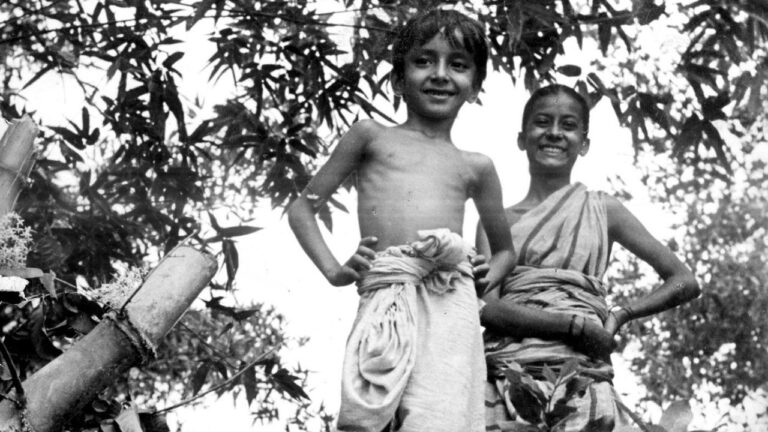
Few could have predicted the impact of ‘Pather Panchali’ when it was first released in 1955, that a simple Bengali film made with non-professionals and supported through loans and government assistance would become such an integral part of global cinema. But this is exactly what Satyajit Ray’s first offering did. Even today, after seventy years, its beauty resides not only in its significance but in its continued ability to move us with its technique, economy, and profound human feeling.
The film, based on Bibhutibhushan Bandyopadhyay’s 1929 novel, revolves around the story of a poor Brahmin family in rural Bengal. The story introduces us to Sarbajaya (played by Karuna Banerjee), who is a tired mother, and also a lifeline of her family. Her husband, Harihar (Kanu Banerjee), has dreams of becoming a writer but can never offer as much as his family needs. Their daughter, Durga (Runki Banerjee), is a naughty child, and her fondness for her younger brother Apu (Pinaki Sengupta) is pure complicity. The entire family has Indir Thakrun (Chunibala Devi), who is their elderly relative, and old age along with her comedy ties the entire family to the past. There is nothing dramatic happening in the narrative, as the impact lies in the manner in which Ray chooses to portray the mundane reality of everyday life, where happiness and sorrow both have common roots.
Satyajit Ray’s Neorealist Lens Finds Universality in the Smallest Details
Ray’s decision to shoot his film on location was both sensible and artistic. Since he did not have much money, he shot his film in real-life villages, using natural lighting and actors who were mainly from outside the film world. This is what was dictated by the Italian neorealist films that Ray admired, particularly Vittorio De Sica’s Bicycle Thieves. Like these films, Pather Panchali is concerned with the dignity of the poor and finds the universal in the most minute details—a rusty cooking pot, a broken wall, or the laughter of a sibling—that become moments of revelation.
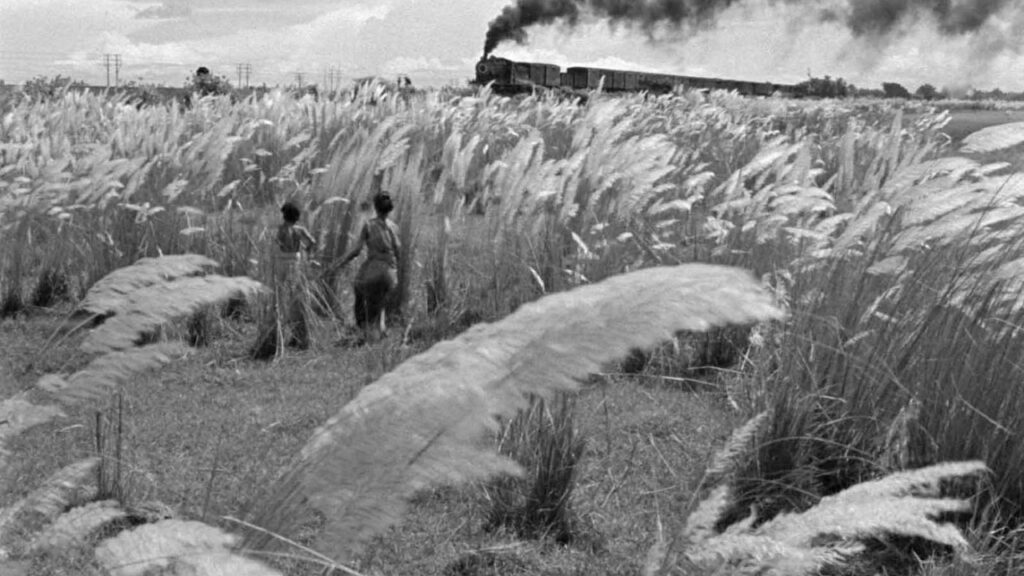
One of the most iconic scenes from the film is deceptively simple, as we watch Apu and Durga sprint through a kaash flower field to catch a glimpse of a train passing through. The children’s joy is evident, but so too is the meaning of the scene, which transcends its surface-level activity. The train, an icon of progress and escape, cuts through the eternal world of the countryside. For Apu, it represents the existence of a world outside the village, and for us, it encapsulates the subtle balance of wonder and longing that defines their childhood. The scene is presented with no obvious commentary, which remains one of cinema’s greatest images of discovery.
Equally remembered is the monsoon episode, where we witness rain pouring down in the village, and kids are playing. However, in this joyous celebration of nature, there is a disastrous threat lurking. Durga becomes ill after taking a bath in the rain and is soon no more. The death is not made spectacular by placing emphasis on it, as Ray chooses to display the collapse of Sarbajaya and the stunned silence of Apu. The last sequences of the film come back to the idea of departure. Harihar returns with gifts and happy news, but falls down when he hears that Durga is dead. Shortly after, the family starts packing their belongings and moves away from the ancestral house, towards an unknown future. Apu looks back at the house that the family is leaving behind, a moment filled with grief, but also with the possibility of new life. It is a very quiet ending, but one that asserts the continuity of life in the face of tragedy.
Karuna Banerjee’s Quiet Power and Ravi Shankar’s Evocative Score Anchor the Film’s Emotion
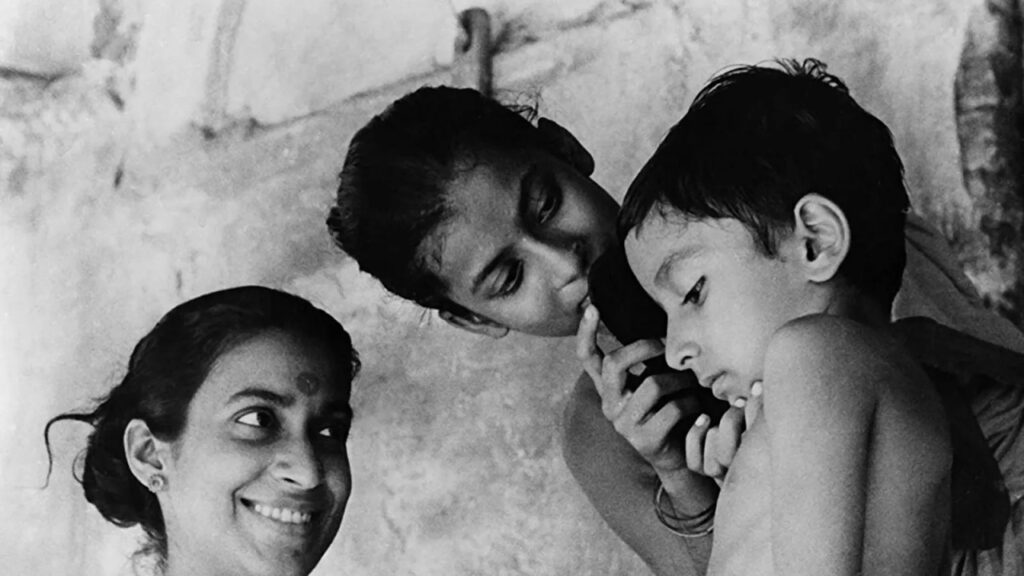
The emotional impact of the film is created by the acting of Karuna Banerjee, whose face, often tense with repressed irritation, expresses strength and vulnerability. She chides her children, argues with Indir, and laments their poverty, but her love shines through. In the moment she collapses in grief at Durga’s death, all the pressures of poverty, motherhood, and disenchantment seem to burst forth in a flash. The role of music should not be underestimated. Ravi Shankar’s sitar melodies, composed in a brief stint of studio recording, create a musical score that is as economical as it is expressive. While it might have overwhelmed the other elements of the film, in this case, it punctuates it, meant to illustrate its playful moments as the children roam about, or a sad melody in response to a tragic event. More frequently, Ray chooses to use silence, letting real-world sounds inform the scene.