Emerald Fennell’s Wuthering Heights is dressed in all the trappings of prestige cinema: star power, beautiful production values, and marketing that promises something bold and new in the classic Emily Brontë novel from 1847. What fans get is something far thinner: a glossy, hyper-sensualized version that replaces the emotional brutality and social commentary of the original with feelings, longing gazes, and visual overload.
With Margot Robbie playing Cathy and Jacob Elordi playing Heathcliff, Wuthering Heights reduces one of literature’s most passionate love stories to a series of sultry tableaux. The film is clearly far more interested in erotic tension and gothic melodrama than in the real meat of the original: class cruelty, obsession, abuse, and how love can curdle into revenge. The film is now mood board cinema: slow motion, wind in hair, bodies pressed together in intensity without purpose or effect.
Glossy visuals and star power dilute Wuthering Heights
One of the biggest problems is Heathcliff. The original Heathcliff is one of literature’s great anti-heroes: terrifying in his cruelty, wounded in his love, shaped by his experiences of rejection and rage. The Heathcliff in Wuthering Heights is simply a tortured heartthrob. He is treated like a mythical figure in a fantasy romance, emerging from fog and towering over Cathy (Margot Robbie) in dramatic poses until all sense of danger or moral complexity is drained from him. The fan of the original is likely to feel what is missing very quickly.
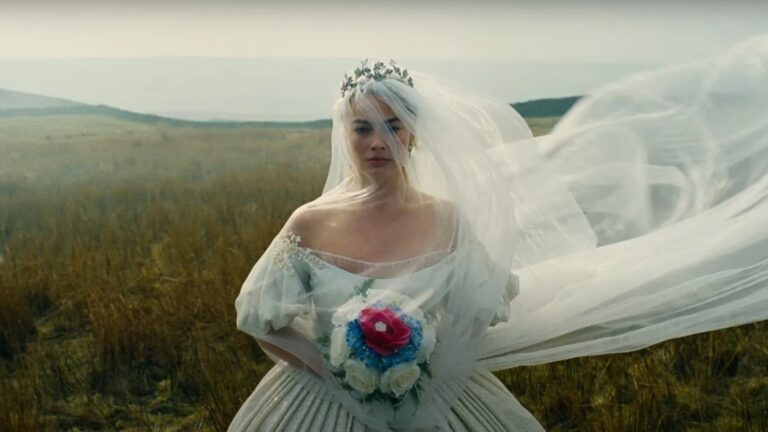
While Wuthering Heights is beautiful to look at, with production values that make the moor landscapes dreamlike and uncanny, style is again overpowering substance. Every frame is screaming with significance, but the story is again becoming very simplistic.
The biggest crime is that Wuthering Heights completely fails to address issues of race and class. By removing these issues entirely, Wuthering Heights removes what made Wuthering Heights both radical and subversive in the first place.
Wuthering Heights is not an adaptation; Wuthering Heights is an aesthetic remix. Beautiful, provocative, empty. It wants to be daring and transgressive; it wants to be seen as bold and new. It is none of these.