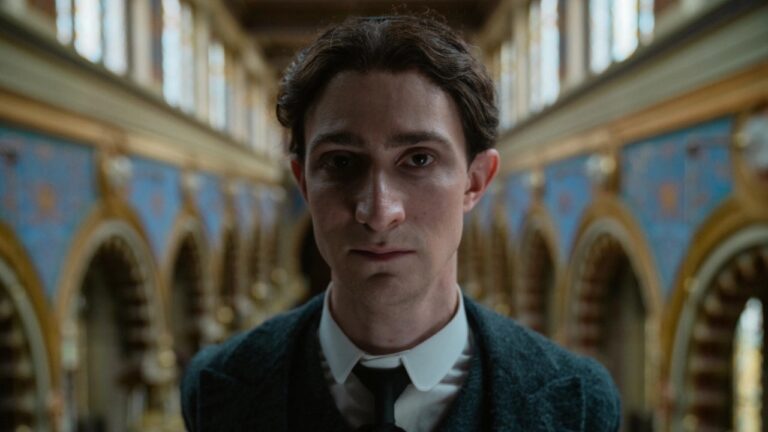
This year, Guillermo del Toro is not the only foreign filmmaker who is pursuing a lifelong dream of realizing a passion for a project. He has given us ‘Frankenstein,’ while Agnieszka Holland has given us ‘Franz,’ which is her unconventional take on Franz Kafka, the famous writer. Holland’s association with Kafka’s works dates back to her teenage days. At the ripe age of 14, she had read his short stories and ‘The Trial.’ What began as a teenage fascination has turned into a lifelong obsession that is now taking shape in the form of a film that is more like a puzzle than a conventional biopic.
“Kafka has been a presence in my life since I was 14 years old, which was the first time I read his short stories, and then ‘The Trial’,” Holland says, but it is difficult to avoid the conviction that the film director’s obsession has approached the level of personal mythology. She describes him as a contradictory figure, that is, accessible and elusive, and confesses with a certain wistfulness that she had thought of looking after him, as if she could safeguard the real man behind the literary myth.
Agnieszka Holland’s Restless Method Between Order and Chaos
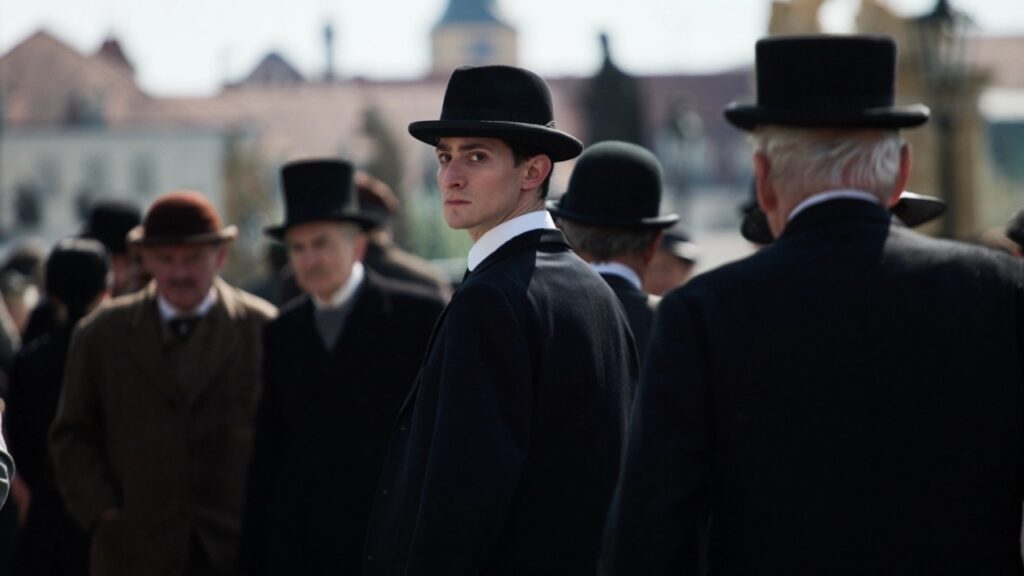
The presence of Kafka impacts Holland’s formative years’ decisions, such as her decision to go to Prague so that she could walk the same routes as Kafka. However, the Prague that Holland sees is one that has commercialized Kafka into a product that is swamped with souvenirs, statues, and even a museum that caters to the needs of the tourists. Kafka has become a tourist destination, and after a certain point, the man behind Franz began to get really annoyed about this. It is easy to feel the frustration that Holland is feeling.
But her initial serious engagement with Kafka on screen came in 1981 when she adapted The Trial for Polish TV. Holland found this experience incredibly informative as she watched that moment come about, and she was quietly proud of herself for having captured something so important in Kafka’s oeuvre. Over the years, her intensive study of Kafka’s letters, his diaries, and his lesser-known works had convinced her that the general public had misunderstood him. Franz was never the perpetually gloomy or dark character, and he insists as he talks about how Kafka was always a witty, sharp, and funny man.
Holland was convinced that a traditional biopic would never be able to capture Kafka. Holland knew that a traditional biopic could never capture Kafka, since he never completed his novels, making it impossible to really finish his story. Together with co-writer Marek Epstein, she constructed a story out of fragments about love affairs, family conflicts, minor writings, and symbolic meetings, and culminating in the two-day reception that turned Kafka the man into Kafka the brand. As a spectator, you can almost sense her excitement in putting all the pieces together again.
Holland is remarkably open about her own approach, admitting she is no scholar and that she never intended to teach anyone anything, though her approach obviously embodies a restless creativity which exudes as much chaos as insight.
Moments of Brilliance Amid Uneven Choices
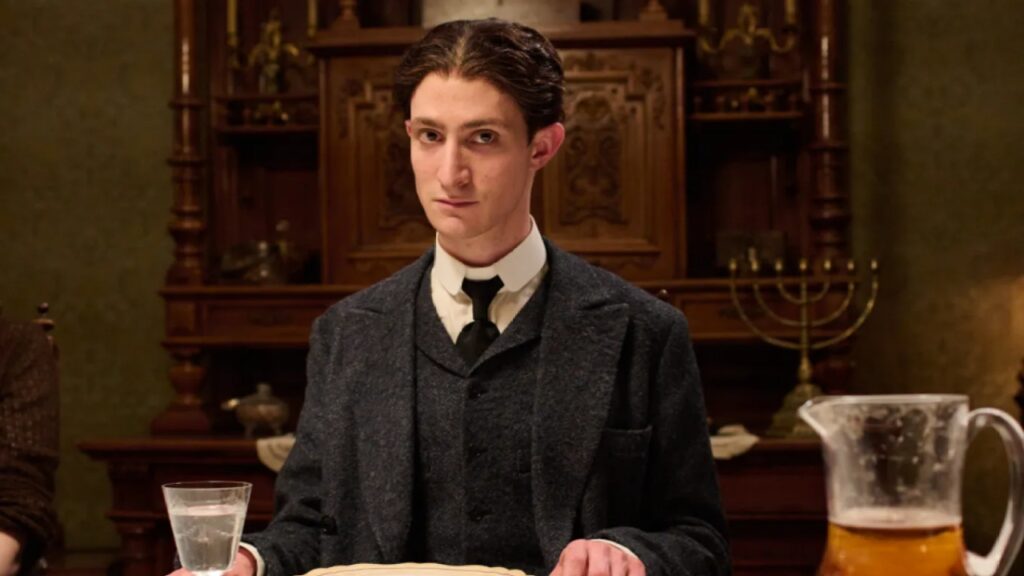
The relevance of Franz, one year after Kafka’s centennial, borders on the ironic. Holland had put off this project to complete ‘Green Border,’ an urgently political film about the Kafka-esque refugee crisis at Poland’s border. For Holland, filmmaking is a means of truth-telling, a reaction to the reality that can still be influenced while it is current. To watch ‘Franz’ is to understand why her attention to detail is so obsessive, as shown in the film through letters and manuscripts written by hand, copies of originals that recreate the presence of Kafka in the bustling museum of Prague, where the past is trampled by the masses as if they didn’t know its fragility.
But for all its passion, Franz often stumbles. The screenplay by Holland and Epstein meticulously outlines Kafka’s life, including his teenage readings, long-distance love affairs, domestic squabbles, and tubercular death. But it rarely adds any new understanding of his inner workings. The characters are reduced to types, the dialogue is often direct quotes from Kafka’s writings, and the literalism of the storytelling allows for no surprises.
But that is not all, as there are moments of brilliance in her work. The In the Penal Colony is darkly comedic, viscerally ambitious, and thoroughly alive to Kafka’s unsettling wit. But such moments are frequently obscured by ridiculous stylistic choices, a cherry mired in a fallen Kafka, a bare tug-of-war action sequence, and anachronistic indie rock songs that seem more distracting than daring. The thematic aspirations of the film, from Kafka’s Jewish heritage to his difficulties with intimacy, unfortunately remain underdeveloped. Nevertheless, Franz is full of heartfelt intentions. Holland’s awe at Kafka’s genius is evident throughout. The film exudes passion and dedication, even if it goes overboard on maximalist details. Viewing the film, you can feel the director’s love for the subject and his work, as much as the latter fails. Franz can be flawed in its approach, but it never lacks inspiration. This, despite its flaws, makes it different from more mainstream biographical films, as it is an ambitious, messy, and passionate tribute to a literary giant who, like Holland herself, is an outsider looking in. Franz marked its debut at the Toronto International Film Festival in 2025 and is currently searching for a distributor to release it to the masses in the United States.