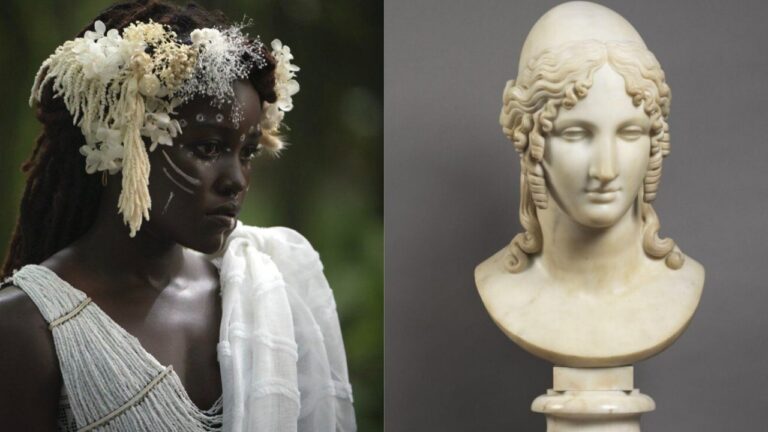
The casting of Lupita Nyong’o in the role of Helen of Troy in Christopher Nolan’s The Odyssey, a film based on the legendary epic written by the ancient Greek poet Homer, has sparked a highly passionate and unprecedented cultural discourse. The basic question that is being raised is how Christopher Nolan’s film might redefine the concept of beauty in terms of legendary epics. It is to be noted that, in the first place, Helen of Troy is not just described as a beauty in Greek mythology but is described as a supernatural beauty whose presence has the potential to change the course of kingdoms and history.
The Odyssey uses Lupita Nyong’o’s Helen to explore timeless, nonliteral divine beauty
The casting of Lupita Nyong’o as Helen of Troy might be seen in terms of presenting divine beauty in terms of modern-day filmmaking. It is also possible that Nolan is presenting a more ethereal and divine concept of beauty that cannot be attributed to geographical location, race, or historical periods, as hinted by the casting of Zendaya as Athena, who is Zeus’ child.
The casting of Lupita Nyong’o as Helen of Troy has been criticized on various social media platforms, as it is against the historical and literary accounts as depicted in the epics written by Homer, wherein Helen of Troy is referred to as “fair-haired” and “white-armed.” The critics of the casting have argued that these terms refer to a particular race and type. However, on the other hand, the proponents of the casting have argued that these terms are metaphorical and symbolic and that consideration has been given to the times.
However, more relevant than these terms is that Helen of Troy was born from an egg as Zeus, her father, transformed into a swan. This means that Helen of Troy cannot be associated with any race, geography, or type. Adding another dimension to the casting choice of Lupita Nyong’o as Helen of Troy and its implications is that Nolan might have other plans for Nyong’o, as she might be cast for multiple roles in Nolan’s upcoming film, such as that of Clytemnestra, Helen’s sister. Nolan, as mentioned above, seems to have a fascination for duality and the dual paths that women born of divine lineage have to take.