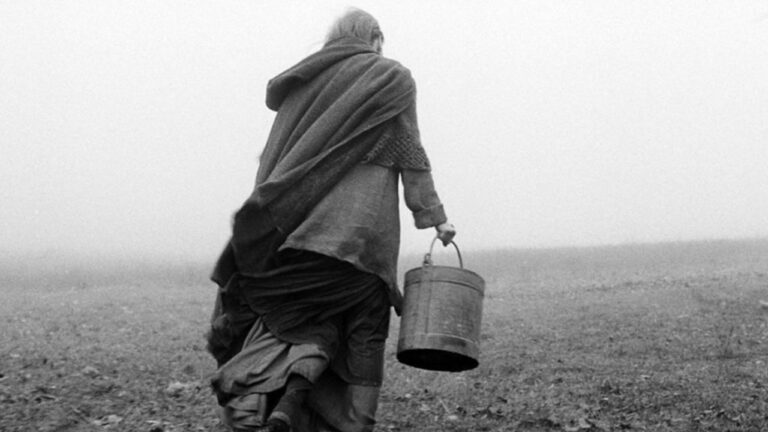
The Turin Horse is the final work of Béla Tarr, an uncompromising close not only to his filmography, but also to the whole concept of human survival in the face of a disintegrating world. In collaboration with Ágnes Hranitzky, this film can trace its roots back to the philosophical myth of the notorious collapse of the great Friedrich Nietzsche in Turin in 1889, who was believed to have embraced a beaten horse before entering his impending madness, and instead of giving us a film about this famous philosopher, they opted to focus the film on the mysterious horse and its owners, a father and daughter, living in a world which is rapidly turning into a desolate wasteland.
Béla Tarr Portrays The Relentlessness of Life and the Heaviness of Human Existence
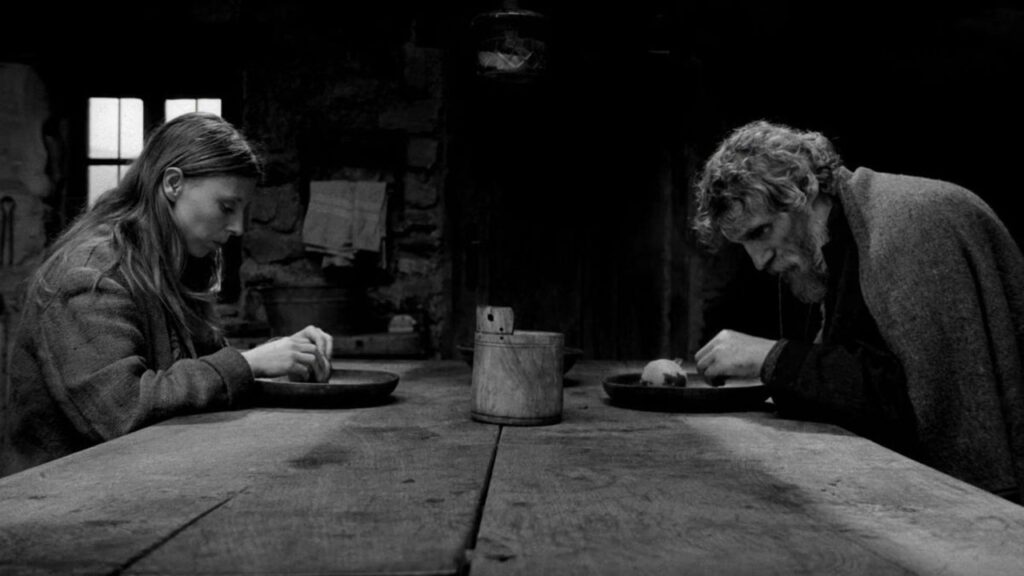
The story is almost absent because it develops in six days and 30 long takes. Every day, the same actions are repeated by the peasant and his daughter. Dressing, having water, boiling potatoes, and attempting to control the horse. Of course, this does not tell us much about the static story because, with each passing day, something is lost from their world. The horse becomes aggressive and refuses to eat or work, the well runs dry, the neighbors come and go with bad news, and light is extinguished.
The recording of this film has been carried out in minimalist black and white cinematography by the cinematographer Fred Kelemen. He has made sure that this film is considered the enactment of elemental forces by the presence of wind, dust, and silence. The windstorm prevailing outside the cottage is thus a cosmic enemy, which is apathetic yet suffocating.
The Turin Horse Reduces Existence To Repetition, Decay, and Darkness
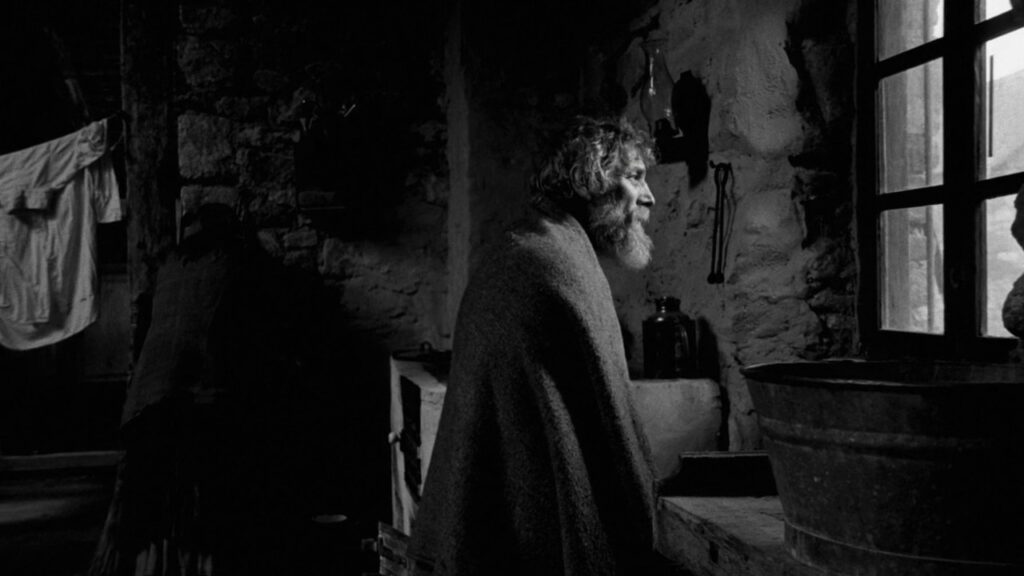
However, we would like to highlight how the musical composition by Mihaly Vig, which included the circling lament of strings and organ, was used to convey the inevitability of the events as if time itself was collapsing on the characters. The interesting thing about the film Turin Horse is that it does not offer any consolation in terms of storytelling by following the same pattern of resisting allegory as strongly as the story itself. The father and the daughter are rather a symbol of strength than anything else because they had lost their identity in favor of rituals in a world that was no longer fit for life. This movie, as Tarr says, “is about the weight of existence,” and the speed of this movie never slows down in its descent because it is an anti-epic, which means a very heavy story in which nothing opens up, only closes until the very end. It has the drive to be a kind of cinematic testament to Tarr, who is the last film he made. While Sátántangó was an epic tale that lasted seven hours and told the tales of the cycles of corruption and delusion of a ravaged village, The Turin Horse is a focused narrative that zeroed in on six days at the edges of existence. While both movies are about the ideas of futility and repetition, where Sátántangó exposed the eternal failure of human endeavor, The Turin Horse ponders the thought of the end of the movement, will, or hope. Finally, we arrive at an understanding that the movie is more about the idea of cosmic exhaustion than Nietzsche’s myth. It is about what remains after the animal, human, and earth itself no longer have the capacity to support life. To observe it is an exercise of courage, but also an exercise of existential observation about the end of stories, the end of cinema, and the end of musing. Tarr thus ends his career with extinction instead of catharsis, putting his viewer in silence, in a world without light.