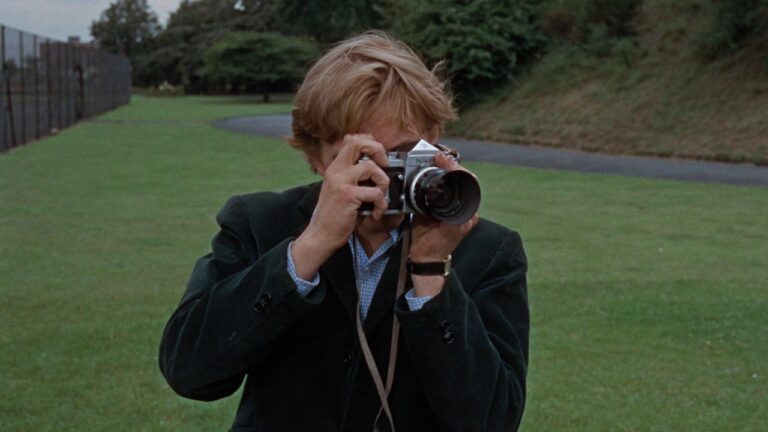
In Blow-Up, which dates to 1966, Michelangelo Antonioni did more than echo the cultural vibrations emanating from Swinging London. Instead, he revealed a philosophical rift beginning to fissure modern culture. The director’s first foray into an English-language project occurred when photography, fashion, youth, and media overload were altering the very fabric of reality. And Blow-Up took that reality and posed a revolutionary question: What becomes of truth when evidence fails?
Blow-Up won the Palme d’Or at the 1967 Cannes Film Festival and soon established itself as a paradigmatic critique of cinema. Its open-ended storytelling, lush eroticization, and refusal to answer the question at the center of the plot further destabilized Hollywood’s Production Code era. It precipitated the introduction of the MPAA ratings system in 1968. The real subversion was elsewhere—that reality was decentered and unknowable.
The murder that may not exist
The film centers around Thomas (David Hemmings), a successful, although spiritually empty, fashion photographer who wanders from photo shoots to parties to one-night stands. He seems to live the dream life, although Antonioni presents it as empty movement. A turning point comes when Thomas takes pictures of a couple in Maryon Park and then develops the photos. He succeeds in blowing the images up enough to reveal to him the image of a murder: a man holding a gun behind the trees and what seems to be the body in the grass.
However, Blow Up resists the machinery of the traditional thriller. Evidence disappears as soon as it is discovered. When Thomas goes back to the park, the body is there for a moment and then is simply gone. Thomas’s negatives disappear from his darkroom. There is no authorities’ involvement and no explanation forthcoming. The enigma becomes unwieldy and implodes in on itself, leaving Thomas and the viewer with nothing to grasp.
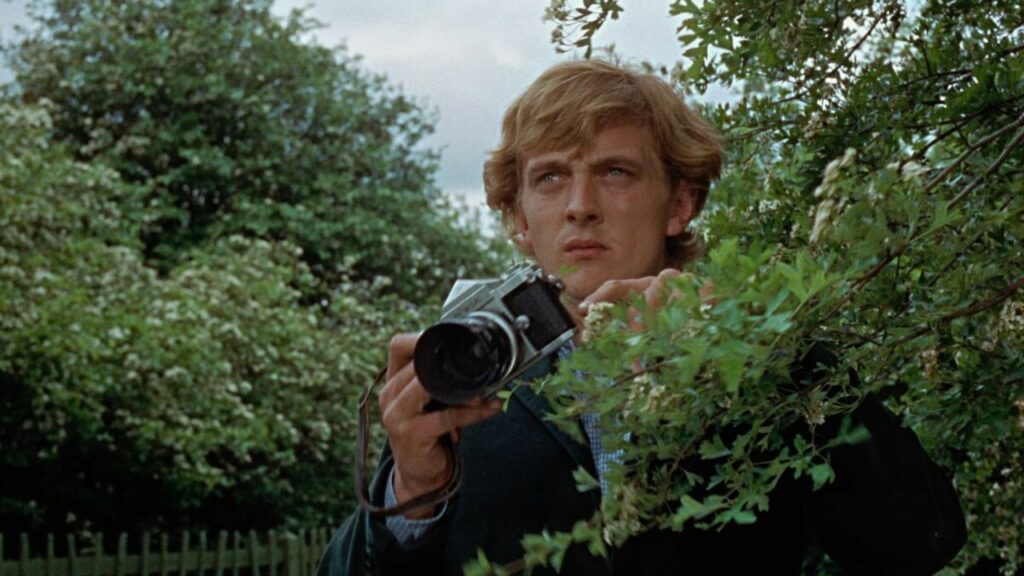
However, theorists and scholars alike contend that the act of murder is irrelevant in the film. Gordon Gow suggests that the act of murder is the ‘MacGuffin’ in the film—a tool that leads to the exposure of the psychological fragility of the protagonist. His confidence in technology and control is lost as the photographic image is ‘abstracted.’ The more he attempts to enlarge reality in order to understand it, the more reality is broken down into ‘meaningless grain.’ Antonioni utilizes photography—a tool that is traditionally associated with the truth—to establish the truth of uncertainty in the film.
This is the theme reflected in the breakdown: the disconnection between man and reality in the modern world. Thomas has wealth, power, and creative expression, but none of them brings him down to earth. The truth is obscured, not revealed, through material success in Blow-Up.
The last scene of the film closes Antonioni’s argument. Here, Thomas comes upon a group of mimes playing tennis in a park. Initially, he watches them in amusement. But when the imaginary ball goes out of play, the mimes ask him to return it to them. Thomas paused and did the deed by tossing nothing. Only then is the sound of a hitting tennis ball heard.
Reality has become, Antonioni implies, not a discovery but a consensus. In accepting the illusion, Thomas reaches a paradigm of meaning unachievable through the evidence of the physical world. His likeness dissolves from the scene in order to leave the empty park. The observer vanishes with the certainty. Why does Blow-Up still resonate with us so strongly? Why does it continue to speak to us with such force in an era of Photoshopped images, digital reproduction, and information decay? The reason is that Blow-Up accurately assessed a crisis that has simply continued to escalate. Blow-Up does not contend that reality is a construct. But it does state that reality is no longer something that can be believed. In Blow-Up, the truth does not meet a brutal end. It simply disappears while we’re still looking for it.