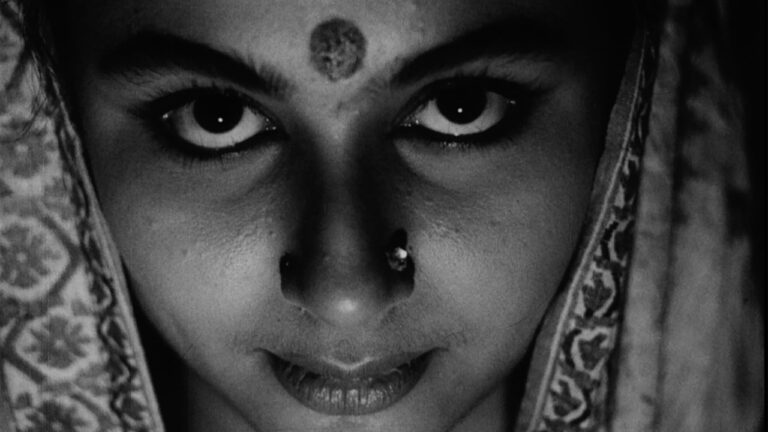
Devi by Satyajit Ray retains its place in the list of most disturbing films in Indian cinema. This film, made in 1960, goes beyond the humanistic realism presented in the Apu Trilogy and enters into the dark areas that make the story both personal and allegorical.
“Devi,” based on a short story written by Prabhat Kumar Mukhopadhyay, is an analysis of the destructive potential of blind faith in rural Bengal during the 19th century. The fulcrum upon which the film turns is the stellar performance by Sharmila Tagore as Doyamoyee, a young girl who finds herself, unwillingly, to be a living goddess.
The Psychological Tension in Devi as We See Doyamoyee Caught Between Faith and Fear
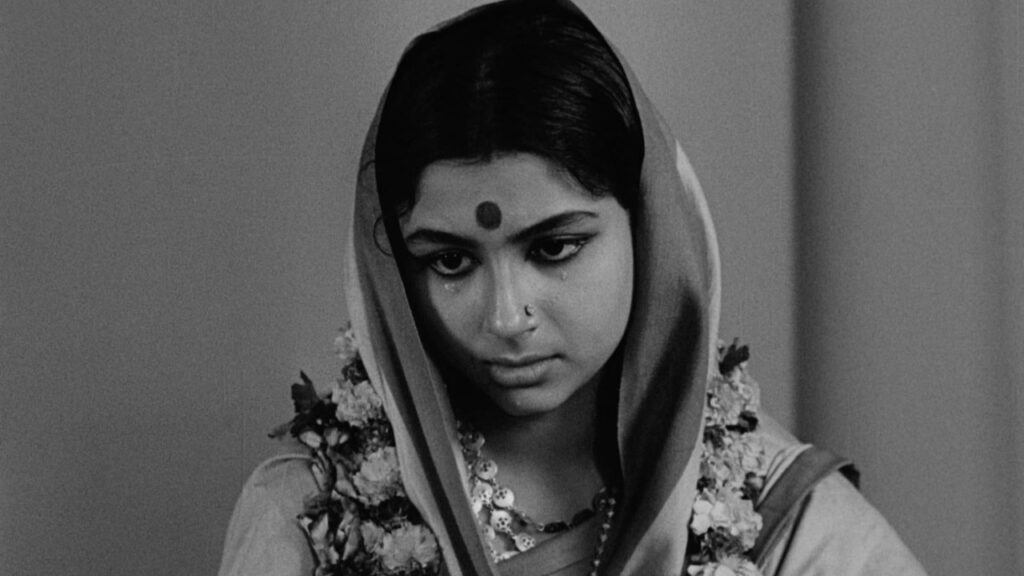
The premise is quite simple. Doyamoyee, married to Umaprasad (Soumitra Chatterjee), lives with her father-in-law, Kalikinkar (Chhabi Biswas), a devout landlord and very religious man. One night, Kalikinkar has a dream where his daughter-in-law, Doyamoyee, is the reincarnation of goddess Kali. When he receives this revelation, he starts worshipping Doyamoyee, and soon the news reaches the entire village. People start thronging there for miracles, leaving their offerings at her feet, and crediting cures to the presence of the goddess. Doyamoyee is also caught up in all this, between reverence and terror, with her own identity merging with that of the goddess she is meant to embody.
Ray sustains this narrative with such an economy of detail that it only contributes to the tragedy he unfolds. There is nothing in this film that celebrates or laments religion on a grand scale. Ray has his own style, and as such, he introduces us to the close-up of the inquiring eyes of Sharmila Tagore, the shadow on the face of Kalikinkar, the silence that is broken by the sound of the blowing of the conch shells and the bells in the temples.
Faith, Fear, and the Faces That Speak Volumes is The Enduring Power of Devi
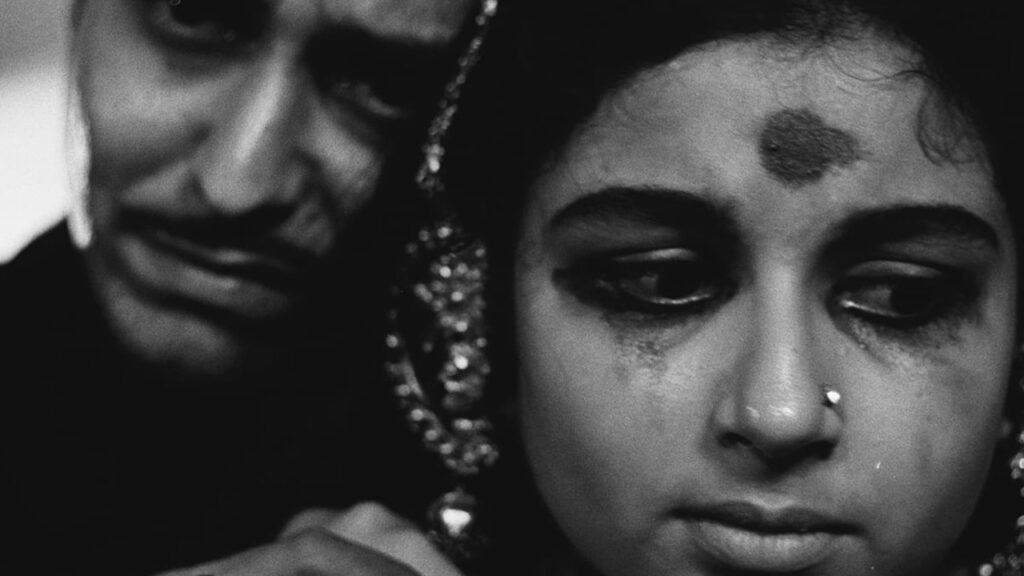
The effect is instantaneous, and it is more of psychological horror than social commentary. The most frightening thing about this movie is its ambiguity, as the audience is left wondering whether Doyamoyee is being taken advantage of in matters of superstition or whether she herself starts to believe that she indeed is some kind of deity. This ambivalence is maintained in the performances with a subtlety that is quite amazing. Sharmila Tagore, who was just sixteen at the time of the shooting, reveals in her performance a certain vacillating between naivety and terror. Soumitra Chatterjee, who plays the rational husband returning from Calcutta, represents reason itself, but his inability to save his wife also speaks of the impotence of reason in the face of deeply ingrained faith. And Chhabi Biswas, who plays the patriarch blinded by devotion, gives perhaps his most memorable performance. At a thematic level, Devi has much to say that goes beyond the concerns of its time. More than a film about 19th-century Bengal, Ray uses Devi to investigate the blindness of faith, the institutionalized subjugation of females within a patriarchal system, and a collective readiness to deliver those we deem worthy to the burning altar of cultural myth as a means of perpetuating those myths. This is the heartbreaking message, as the child is sacrificed for the perceived blessings brought on by Doyamoyee, leading to a healing death, simply because it is accompanied by neither spectacle, which is merely quiet. It has been more than sixty years since the release of Devi, and the film is still disturbing. The very questions of belief, intellect, and cost that remain still are disturbingly valid. Ray does not offer any consolation but instead presents us with a portrait of a young woman smothered by the various roles that have been imposed upon her, and her humanity lost under the weight of divinity. The film stays long after the credits roll, daring us to not only understand the historical realities that exist within it but also its contemporaneity in the presence of said belief structures that continue to play a role in the present.