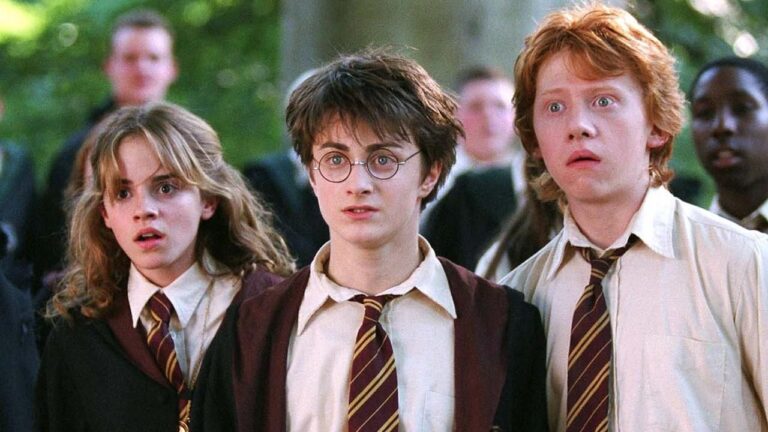
’Harry Potter and the Prisoner of Azkaban’ is sometimes regarded as a crucial moment in the series by J.K. Rowling. This is the volume where the tone becomes darker and more complicated. In his third year at Hogwarts School, Harry must contend with the menace of Sirius Black, an escaped prisoner from Azkaban who is presumed to be out to get him. This volume allows the reader to get right inside Harry’s head.
It also shows more about his parents and their friends. We are introduced to new magical elements such as the Marauder’s Map, Buckbeak the Hippogriff, and the Dementors, which impact Harry intensely. Such elements of the story enable us to appreciate the characters and the world in which they live.
Visual Depth and Narrative Condensation in Harry Potter and the Prisoner of Azkaban

The film directed by Alfonso Cuarón handles the situation differently, as the third part of the depiction of Hogwarts School of Witchcraft and Wizardry appears darker and more mysterious. The rain, darkness, and fog surrounding the castle make it rather ominous. In fact, the characters are growing up, and the narrative is becoming increasingly mature. There is a lot of visual storytelling, allowing us to experience the atmosphere and the tension. Fear and danger lurk in the corners of the frames, but the film does not have the capacity to explore Harry’s thoughts. This film allows us to witness the responses and expressions of Harry but does not provide us with the same insights into his thoughts as the book offers.
The story of the book is developed, especially when we learn that it was Peter Pettigrew who betrayed Harry’s parents. There are clues and dialogue that lead us to the discovery. The story of the Marauders is revealed, where we see James, Sirius, Remus, and Peter as friends, and this teaches us about loyalty, mistakes, and the power of friendship. This is all simplified in the movie. The Marauder’s Map is introduced, and we learn the names of the Marauders, but the pace goes by rapidly. Fans have complained that the suspense and the importance are lessened since the backstory of the betrayal is not developed.
The Dementors are another area where the book and movie differ. The Dementors in the book are as much a psychological factor for Harry as they are physical ones. We feel his fear, his hopelessness, and the aftereffect that they have on him. The Dementors in the movie are scary to watch, and they are very well created, but they are more about how they look and how they move rather than how they affect Harry psychologically. This is one of the areas where we realize that a visual form of art cannot always portray the same experience that a book can.
The Time-Turner sequence is another case. In the book, Hermione has everything planned out. We see how she times things so that Buckbeak and Sirius are saved. We understand her thought process. In the film, the sequence is more streamlined. You can see what is going on, but it’s not as clear how the planning works, or how clever Hermione is being. This view is that it makes the pace of the story feel quicker, but that we lose the benefit of reading the book.
Another area where the book and movie are different is in the development of the characters. In the book, we experience Harry’s thoughts and feelings, which reveal his character development as he deals with fear, treachery, and morality. We witness Hermione’s intelligence and sense of morality. Ron’s loyalty and perseverance are apparent. Lupin’s battle with his condition as a werewolf and his kindness are fully developed. In the movie, we watch the actors’ facial expressions to sense these qualities. Even though their acting is superb, we cannot observe the level of reflection that occurs in the book. However, in spite of all these differences, both the book and the film do something very important.
The book allows us to experience the entire story with all the turns and complexities of the characters. The film gives us a picture of the world that is alive and real, and captures the danger of Harry’s third year. Both of them allow us to experience the story in two different ways. You can read the book to learn about thoughts and details, and watch the film to feel the atmosphere and see the magic. Harry Potter and the Prisoner of Azkaban demonstrates how different forms of media convey a story in distinct manners. The novel allows us to be inside Harry’s thoughts as he comprehends the backstory of the Marauders, as well as the strategic planning on the parts of Hermione and Harry. The film allows us to experience Hogwarts through pictures and motion, experiencing threats, secrets, and the development of the characters towards maturity. And let’s be honest—both are necessary. We can appreciate the novel for its depth and the film for its artistic expression.