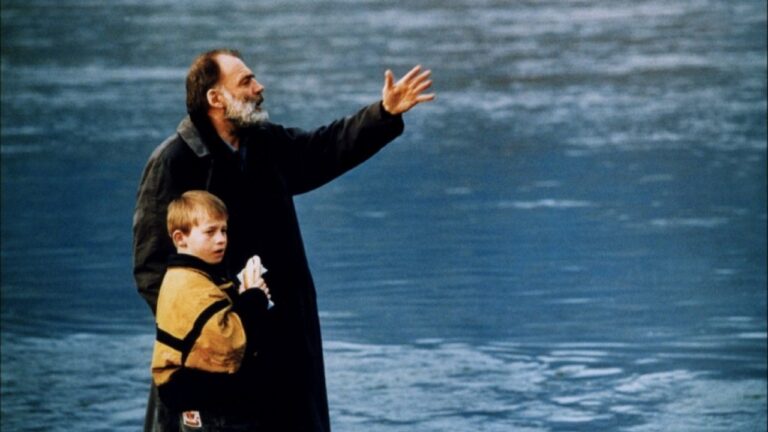
In ‘Eternity and a Day‘ (1998), a film directed by Theo Angelopoulos, the character of Alexandros is portrayed. He is an elderly poet in whose mind the realization has dawned that the end of his life is nearing. He spends his last days wandering around the streets of Thessaloniki, trying to decipher what’s left of his past. He also walks around the rooms of his vacated house where, once upon a time, the sound of voices and laughter filled the air.
Thoughts of his deceased wife haunt him, and we are able to see just how much she has influenced his life. His daughter, now a teenager and estranged from him, symbolizes the time that he can no longer hold at bay. However, all of this changes when Alexandros encounters a young Albanian refugee boy, searching for food and shelter.
Acts of Care That Give Life Its Weight

The encounter between the poet and the boy, who was kidnapped and sold from his hometown, seems coincidental, but it gives Alexandros a purpose in these last hours. While he is considering whether to help the boy or not, we observe two lives that are utterly different and very much linked. The old man, who had lived among books and words, encounters a boy with no home and very limited words to convey his thoughts. Because of this contrast, the journey that these two will undertake together will be both real and symbolic.
As they move through the city, which looks at once familiar and strange, the film illustrates the way in which time and memory are always intertwined. Angelopoulos presents the streets that seem to have remained unchanged for decades, and the faces that bear witness both to the exhaustion of the past and the unknowns of the future. The long and deliberate camera movements enable us to look and think, rather than simply passing by. The fog, the sea, and the gentle motion of people all become part of the emotional vocabulary of the film.
After all, it is through these small and simple moments that we begin to understand the state of Alexandros’s mind. The music by Eleni Karaindrou contributes tender emotions to the images, reminding us that what he is going through is not only sorrow but recognition and release as well.
Understanding Life Through Others and Ourselves

What makes the movie so potent, though, is its ability to weave the story of one individual with the story of a nation and a continent in flux. The refugee boy symbolizes the new world that is emerging for Alexandros, one which he does not entirely understand anymore. However, in watching him care for the boy, it becomes clear that compassion is still a possibility even when there is a lack of understanding. As such, the movie is something more than a farewell. It is an exploration of what it means to be among others even in a situation where time is running out. But by the end, Alexandros has not solved any problem, but he has found some sort of peace. He knows that memory is not meant to be precise or whole. It is in fragments, in gestures, in the sound of a loved voice, or in an act of kindness. We can see Alexandros standing by the sea as a man who is no longer fighting against time but instead moving along with it. Eternity and a Day teaches us that it is not what we have achieved that gives life its meaning but instead the moments of connection that are left after everything else fades away.