

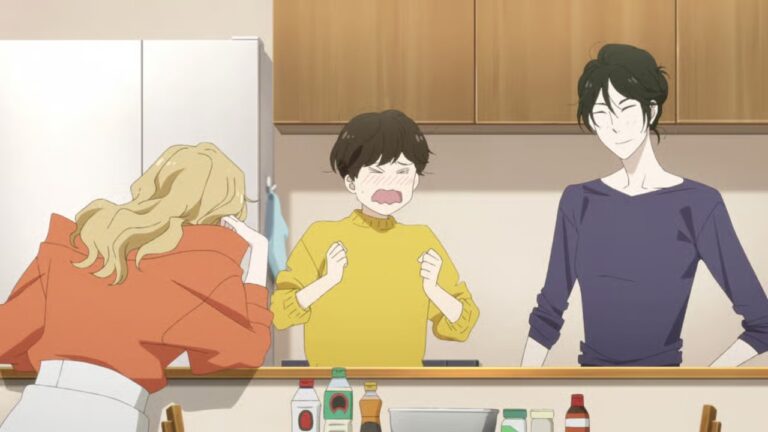
Makio Koudai has always preferred a quiet life with her books. Things take an unexpected turn when she becomes the guardian of her 15-year-old niece, Asa, after a sudden family loss. The two are almost strangers at first. But living under the same roof slowly begins to change that. Journal with Witch explores how they learn to build a new sense of family together.
A Stranger at the Door
Based on Tomoko Yamashita’s eleven-volume manga, Journal with Witch, known in Japanese as Ikoku Nikki, meaning “foreign diary,” is one of the most quietly devastating anime to come out in recent years. It holds an 8.9 on IMDb and a near-perfect 4.8 out of 5 on Crunchyroll, and the numbers make sense once you understand what the show is actually doing. And no, it’s not a story about dramatic revelations or tearful reconciliations on cue but about two deeply private people who have no idea how to need each other, slowly learning how.
When Asa’s parents die in a car accident, an accident she witnesses, she is left at a funeral surrounded by relatives more interested in gossip than her well-being. Makio, estranged from her sister for years and wholly unprepared for parenthood, is the only adult in that room who treats Asa’s grief as something real. She doesn’t offer hollow comfort. She tells Asa that her complicated feelings are valid, and brings her home.
This one small act of decency establishes the entire tone for everything that will come after it. Makio brings her own baggage with her, having been put down by her sister her entire life because her sister never respected her. Makio will admit to Asa that she cannot love her, at least not yet. And Asa will hold it together with every ounce of willpower in her until the loss of her parents becomes too much to bear. She will pick fights, leave school without anyone to drive her home, and carry a bitterness towards her mother that has nowhere to go.
And Makio will continue to be there. She will notice when Asa sleeps through the morning and will give Asa the room with the journal without ever making it an issue. Makio will listen to Asa when she opens up, never becoming cold or distant, and will attempt to refocus Asa’s attention to where it should be. This will be done without ever becoming loud or boisterous. It will be consistent, and it will be this consistency that will become exactly what Asa will need.
The desert keeps showing up throughout the series, expansive and empty, for every emotion that refuses to be named. Studio Shuga lingers, lingering on empty corridors and missed meals instead of cutting away. This is the work of ma, a very Japanese concept of silence as having meaning and purpose. These two share a life and a routine, but the distance between them is honest, and the series keeps it honest instead of forcing it into a comfortable place.
What develops between them develops as anything worthwhile does, without fanfare. Showing up. Following through. Sitting with someone in their grief instead of talking them down from it. Makio works with what she has, and over time, she finds it’s enough. The series requires nothing of the viewer but their patience, and repays it just as quietly, and just as well, as Makio repays Asa.
You May Also Like:
JJK Season 3 Episode 10 Review: Megumi Pushed to the Brink in Brutal Culling Game Clash


