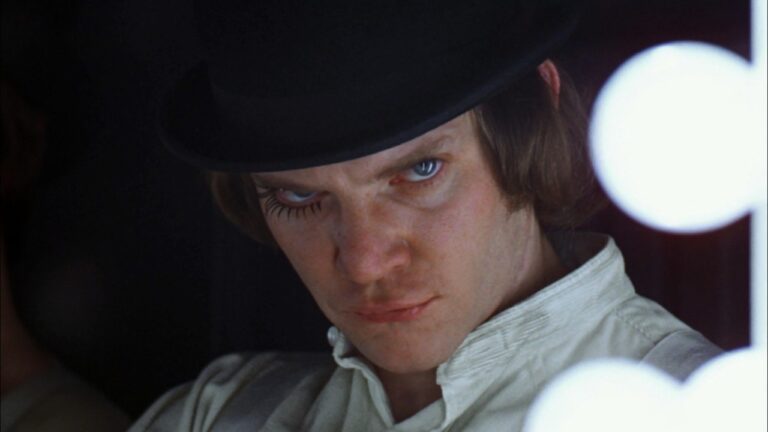
One of the most provocative films ever made is Stanley Kubrick‘s A Clockwork Orange from 1971, not only on account of the violence depicted within it but also due to the disturbing questions it poses about free will, morality, and the use of state power. Based on the 1962 novel of the same name by Anthony Burgess, A Clockwork Orange presents a dystopian future Britain where decay, politicization, and psychological manipulation inhabit the same geographic and temporal space. Shock is not a spectacle for Kubrick; rather, it is a means of compelling viewers to think through the morality of curing evil by eliminating choice.
The figure at the forefront of this film is Alex DeLarge (Malcolm McDowell), the charming young delinquent with an equally charming appreciation of Beethoven music and “ultra-violence.” Fronting his “droogs” on muggings and ravisements through the night, Alex is the living representation of nihilistic depravity. However, to add complexity to this equation, Kubrick also makes this character narrate through Nadsat slang—the deliberate fusion of slang and non-standard language that repels and attracts dual-watchers in equal measure. This betrayal and arrest for murder is a turning point—not towards redemption, per se, but towards another kind of dehumanization.
Violence, conditioning, and the illusion of reform
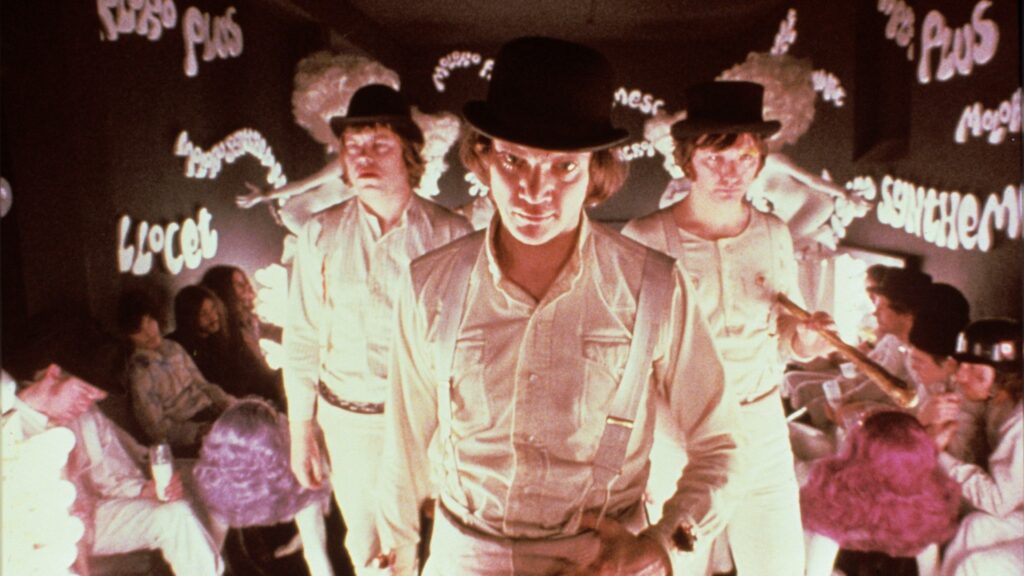
A prisoner facing life imprisonment, Alex elects to undergo the Ludovico Technique, an experimental behavioral conditioning program marketed by the government as the panacea for crime and prison population growth. Sickened and subjected to graphic images of violence, Alex is conditioned against aggressive impulses. Even Beethoven, once synonymous with pleasure, is intolerable. Kubrick reveals the therapy, rather than a corrective process, as a kind of mechanical overhaul, reducing Alex’s humanity and rendering him unable to make choices. “Goodness without free will is no virtue,” warns the prison chaplain.
Human Alex, now free, is exploited by the very people he has wronged and targeted for use by opposing political factions for propaganda purposes. Both the oppressive government and the opposition dissidents exploit Alex for their own ends, and what is portrayed is a morally bankrupt world, one in which ideology is irrelevant and domination is what is at issue. The central metaphor of Kubrick’s film now becomes clear: Alex himself is the “clockwork orange,” a being purporting to be human but reduced inside to a ticking clockwork mechanism. The last “cure,” involving a restoration of Alex’s aggressiveness for political purposes provides no kind of moral closure. Rather, a chilling implication is left for the viewer: a society ready to make a sacrifice of freedom for a measure of control is one in which humanity is the first thing to be sacrificed.