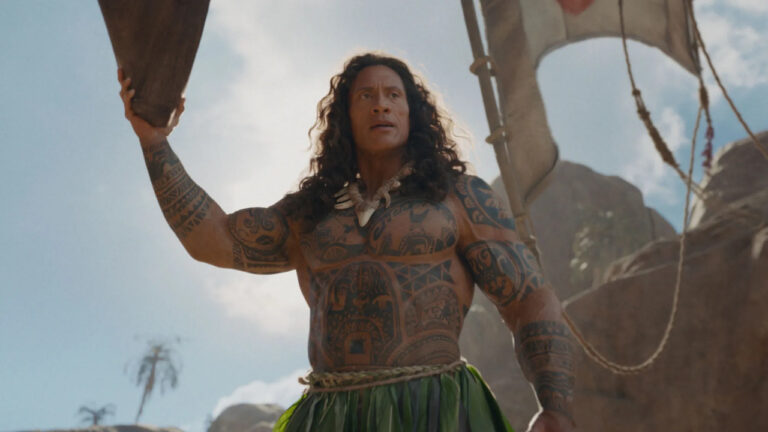
The live-action adaptation of Disney’s Moana is scheduled to hit theatres on July 10, 2026. Dwayne Johnson, who plays Maui in the film, is currently on a promotional run. Making an appearance at CinemaCon, he shared his perspective on masculinity.
Real masculinity is about championing women, says Dwayne Johnson
While promoting the live-action adaptation at the event, Johnson offered an empowering take on masculinity that aligns well with the film’s context. He stated that “real masculinity” champions women and uplifts them to be better versions of themselves.
“All men of all ages should support, champion, and embolden women. To me, and to Maui, that’s what real masculinity looks like,” Johnson said.
The film centers on a female protagonist, Moana, who leads the journey to save her tribe. Maui, despite being a powerful demigod, ultimately supports her mission rather than dominating it. At the event, he emphasized that his character represents a version of masculinity where men uplift women instead of overshadowing them.
Being a Pacific Islander himself, Johnson said the movie hits close to home. He noted that his character, a demigod rooted in Polynesian mythology, made it an “amazing experience” to portray Maui in the live-action film again. Notably, the WWE star also voiced the same character in the animated film, which came out in 2016, and in the sequel as well.
“There’s something special and important [when] you take animation to live-action. We’re able to showcase our Pacific Island, real people, and it’s humbling and inspiring all at once,” the Hollywood star said.
Johnson’s message aligns with modern Hollywood messaging around gender roles and challenges traditional masculinity, which seems to be resurging in the modern era through the manosphere. Earlier, while promoting Moana 2, he reinforced the ideas of modern masculinity by stating that being open about vulnerabilities is not a sign of weakness but strength.
“The idea of asking for help is actually a superpower,” Johnson said, adding, “Powerful masculinity is having the confidence to look inside and say, ‘This is what I’m feeling, and it’s okay. Here’s my chest. I’ll gladly rip it open to someone who can help me.'”
To him, masculinity is not about being a “tough” guy or a “bad—.” Do you agree with Johnson’s idea of masculinity? Let us know in the comments section below.