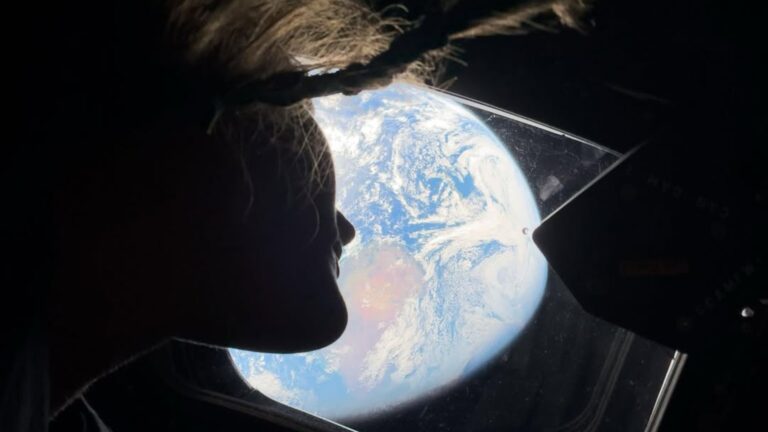
As the Orion capsule crossed over the lunar far side on the night of April 6, 2026, an eerie silence fell across Mission Control at Houston. During these forty minutes of “loss of signal” (LOS), the crew members of Artemis II—Reid Wiseman, Victor Glover, Christina Koch, and Jeremy Hansen—remained in complete radio silence. Though NASA technicians were fully expecting the “radio blackout,” it created a similar effect to when a protagonist is suddenly cut off during a suspenseful chase scene in one of those prestige sci-fi dramas. Specifically, there is an eerie similarity between that moment and Apple TV‘s For All Mankind, especially since its alternate timeline takes place in the early 2020s.
Recreating the “script” of the far side
One of the signature elements of For All Mankind is the moon’s far side being a desolate wasteland of cosmic despair, where astronauts spend days in solitude and isolation. With a new historic distance record of 252,756 miles from Earth broken by the astronauts right before the blackout, Artemis II brought all the elements together to recreate the movie script.
To make things even more dramatic, the team members were fortunate enough to witness a total solar eclipse from the other side of the moon and see the sun’s corona like no other human ever did in history. Christina Koch’s voice, finally returning on air with “It is so great to hear from Earth again,” created that same feeling one gets during emotional reunions and dangerous returns in the series.
For All Mankind revolves around an endless global space race, and 2026 shows us that the events in this timeline will follow our own in time. As much as NASA officials try to spin it, Artemis II is indeed a political statement. Unlike the Apollo-era program, this space exploration effort is aimed at acquiring “lunar real estate” instead of purely scientific achievements.
Not only does China have its own rival program called the International Lunar Research Station (ILRS), but it also plans on landing taikonauts on the moon by 2030, and searching for Helium-3 and rare earth metals in the water-ice-rich South Pole craters, the same places as NASA. In other words, while NASA is looking for “moon gold,” the show depicts a mining base right next to the moon colonies.
As some critics and sci-fi fans like to say, “a radio blackout is such a convenient plot hole.” The thing is, we do not yet have satellites to establish a permanent communication link around the far side of the moon.
Although Artemis II managed to test its O₂O laser communication system with record-high data transfer speeds, we cannot rely on it yet due to the mass barrier posed by the moon itself. These forty minutes of being out of contact with the crew members represent a terrifying reality for astronauts that still requires a modern-day sci-fi solution.
Now that the Orion capsule, nicknamed Integrity, continues on its journey towards a splashdown in the Atlantic Ocean on April 10th, people are starting to notice that the “alternate timeline” presented in For All Mankind is slowly becoming a reality.
No longer is our space program about visiting the moon, but now we are living through a true lunar colonization era. Whether we are heading towards an era of cooperation or military tensions depicted in the show remains to be the biggest cliffhanger of our generation.
For All Mankind season 5 is currently running weekly on Apple TV, with new episodes coming out every Friday.